


Center rallies to save vineyard stock after virus hits


By Edgar Sanchez
For more than 70 years, a little-known complex in Davis—Foundation Plant Services—has supplied healthy plant material in high demand for grape growers and vineyards that sustain California’s nearly $45 billion retail wine economy.
The self-supporting center in the College of Agricultural and Environmental Sciences at the University of California, Davis, distributes virus-tested grape, fruit and nut-tree propagation stock in cooperation with federal and state agricultural agencies.
Now FPS is mobilizing against a vineyard virus: grapevine red blotch disease, a severe vineyard threat identified in California’s North Coast, Central Coast and San Joaquin Valley grape-growing regions, as well as in seven other states since 2012.
The virus is forcing FPS itself to stop growing in one of its two open-field vineyards in Davis.
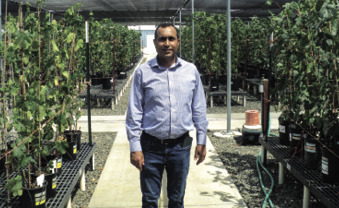
“It is a threat for us, and we are taking action to protect our valuable collection,” said Maher Al Rwahnih, director of FPS and a plant pathologist.
Some vineyard stock is being moved to temporary greenhouses on the Davis campus. Those facilities will be replaced by a permanent $5.25 million, 14,400-square-foot, insect-proof greenhouse that is being built to protect grapevines from red blotch and other disease threats.
Funded with urgent contributions from agricultural research and advisory groups, the facility is due to be completed by late 2023, with a second greenhouse planned within the next two years.
“We are being proactive,” Al Rwahnih said.
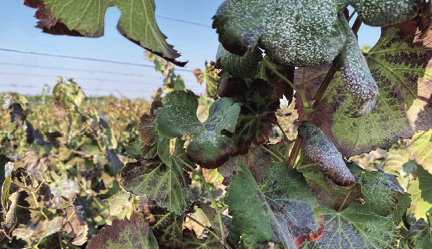
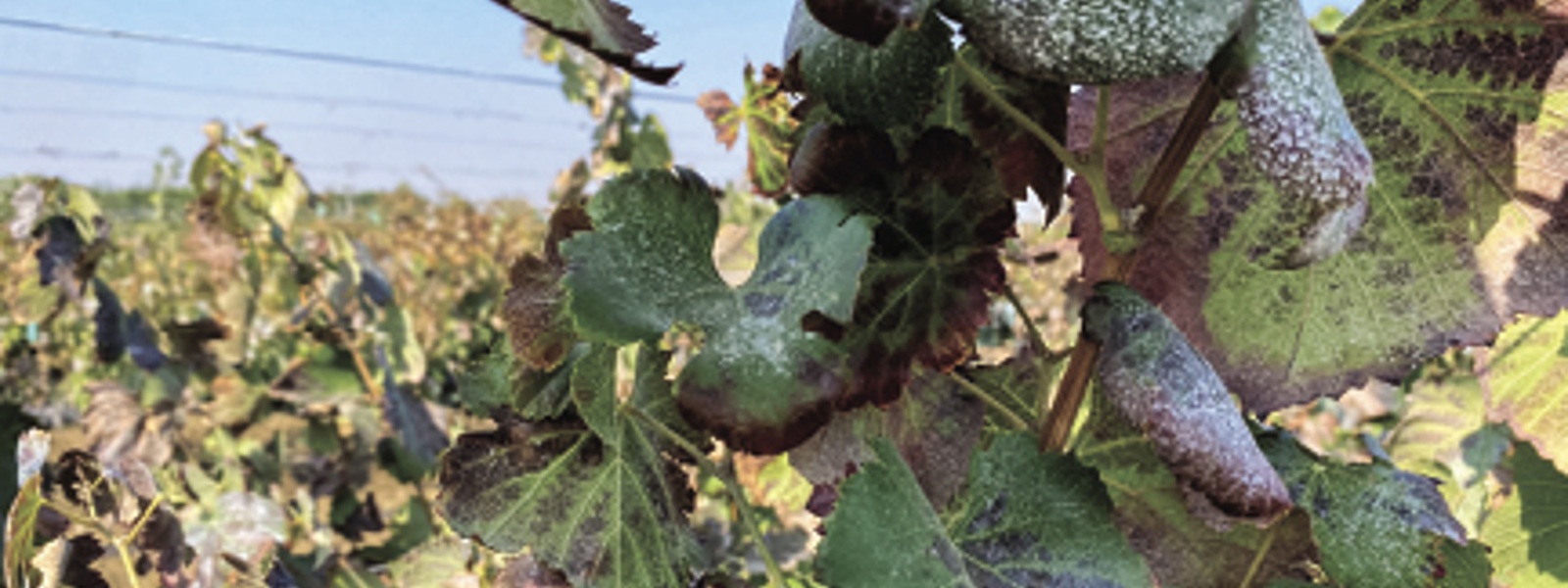
The aggressive steps being taken in Davis to safeguard vineyard propagation materials underscore concerns about red blotch in California, America’s leading wine-producing state. Named for the unsightly red blotches it leaves on vineyard leaves, the virus slows the ripening of red and white grapes, impeding sugar accumulation and flavor compounds coveted by the wine industry.
Once red blotch strikes, “You need to hang your grapes longer to get the sugar content you need,” said Anita Oberholster, a Cooperative Extension specialist in the UC Davis Department of Viticulture and Enology.
The virus can also render that sweetness moot by devastating vineyards, because the only known treatment is to remove entire vines.
As FPS rallies to contain the threat in Davis and safeguard vineyard propagation materials, Oberholster and other researchers from UC Davis, UC Berkeley and Oregon State University are investigating red blotch and trying to identify insect vectors that transmit the disease.
Their work is funded by a $3 million grant from the National Institute of Food and Agriculture. Additional research is underway at New York’s Cornell University.
FPS first detected red blotch in late summer 2017 at its Russell Ranch vineyard in Davis. Then, five vines—or 0.1% of the total tested—had the disease. Recently, nearly 50% of the Russell Ranch vines were infected, Al Rwahnih said.
“Russell Ranch cannot be restored,” he said.
Red blotch has been detected on less than 1% of the vines at FPS’s second vineyard called the Classic, and it remains operational for now.
But no more grapes will be grown at Russell Ranch, and propagation materials from that vineyard are no longer being sold. The property will be used for crops such as roses, pistachios, olives and fruit trees, which red blotch doesn’t harm.
“We’re pretty confident grapevines are the only host of this virus,” Oberholster noted.
Researchers say the virus may have been transmitted to the Davis vineyards by three-cornered alfalfa hoppers or other pests. Al Rwahnih said three-cornered alfalfa hoppers—green insects with clear wings that feed on alfalfa and grapevines—have been captured at both FPS vineyards.
“We know that under greenhouse conditions, the three-cornered alfalfa hopper can transmit the virus, and we have other option insects that we are currently looking into,” said Oberholster, who is coordinating research to identify the vineyard culprits.
“We’re at the stage where we’re almost certain that the three-cornered alfalfa hopper is not the only vector” spreading the virus, she added.
She said preliminary transmission studies at UC Berkeley point to another vector as also transmitting it. But she said researchers still “need to be certain” before announcing findings.
Meanwhile, FPS is reaching out to California’s grape nurseries for assistance in guarding against red blotch spreading.
“We had a meeting with the industry,” Al Rwahnih said. “We decided the best way forward was to put the vines under a screenhouse, or greenhouse protection, away from insect vectors.”
Agricultural groups have provided $4.6 million toward building the first FPS greenhouse on the Davis campus. That includes $4 million from the California Fruit Tree, Nut Tree and Grapevine Improvement Advisory Board and the California Department of Food and Agriculture.
Other funders include the California Grape Rootstock Research Foundation, which provided $500,000, and the California Grape Rootstock Commission, which gave $100,000. Another $450,000 came from FPS.
In addition, the CDFA Pierce’s Disease and Glassy-winged Sharpshooter Board has awarded $648,000 to propagate and test priority grapevine selections in the new greenhouse.
The greenhouse will be the repository—“kind of like the ground zero”—for clean plant material in the U.S. for “multiple decades,” said Dustin Hooper, the Improvement Advisory Board chairman.
By repelling virus-carrying vectors, Hooper said it will benefit “not only the grapevine industry, but it can be used for many of the different crops that FPS grows.”
“We were lucky enough to have some excess funds available, so we chose to step up and support the project (to show) that we are committed to FPS for the long term,” Hooper added. “This is a long-term investment for FPS.”
Al Rwahnih said FPS is grateful for the support, as the fight against grapevine red blotch disease continues. He said the virus likely won’t be wiped out anytime soon.
“Like COVID-19, red blotch is here to stay,” he said. “It is too complex. Now, it’s all about the best disease management strategies."
(Edgar Sanchez is a reporter based in Sacramento. He may be contacted at edgar.chez@yahoo.com)





.svg.png)
