


Heritage club honors farms for tradition and resilience
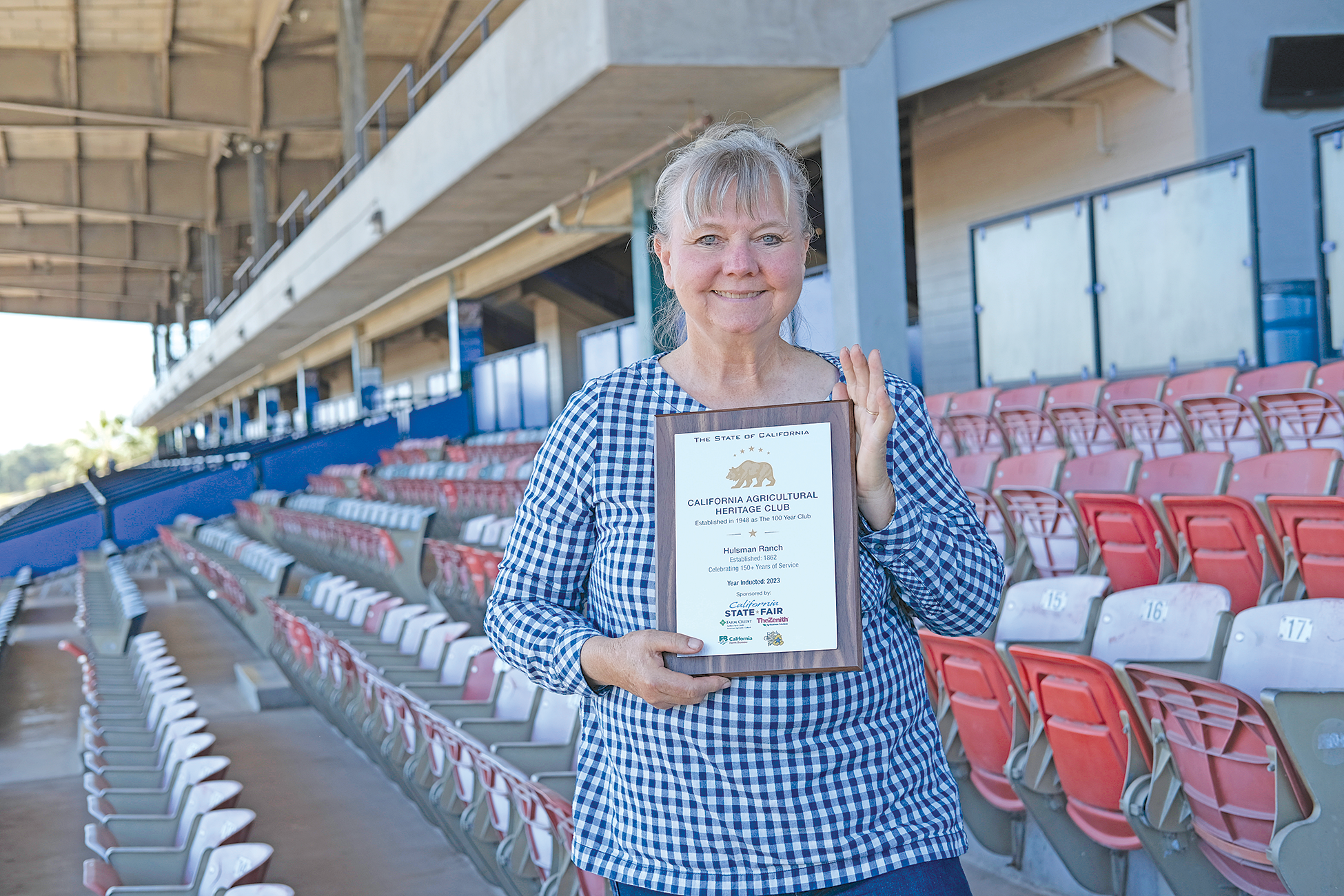
Lassen County cattle rancher Hannah Tangeman received a plaque on behalf of Hulsman Ranch, which was honored by the California Agricultural Heritage Club for 150 years or more of continuous operation. The ranch, which has been run by women since 1914, was established in 1862.
Photo/Caleb Hampton



By Caleb Hampton
In 2020, historic Hulsman Ranch was no match for the Sheep Fire, as flames destroyed most of the Lassen County cattle and timber operation. Undeterred, Hannah Tangeman, who runs the ranch with her sister Susan, slept on a cot in the meadow and kept watch for the sheep and cattle.
“In case the fire encroached,” she recalled, “I was going to cut more fences to get them into the neighbors.’”
The animals went unharmed, but the fire burned 90% of the trees, wiping out the timber business and leaving hillsides bare and vulnerable to floods that further devastated the land a year later.
More than a century and a half into business, Hulsman Ranch, which was established in 1862 and has been run by women since 1914, had to start over. Earlier this year, the ranch replanted 100,000 trees.
“I didn’t think my golden years would be covered in ash,” Tangeman said, “but they have been. My hope is that the trees will grow, that we’ll be able to sustain our irrigation system, that we’ll be able to sustain our ranching operation and move into the future.”
Last week, the resilience of the Tangemans and other California farming and ranching families who have operated continuously for 100 years or longer was celebrated at the California Agricultural Heritage Club’s annual breakfast and awards ceremony at the California State Fair.
The club, which comprises descendants of some of California’s earliest agricultural businesses, was “created to acknowledge the families, businesses and special ag interests that have maintained a financial responsibility in California for more than a century,” said Judy Culbertson, chair of the California Agricultural Heritage Club and executive director of the California Foundation for Agriculture in the Classroom.
In 1948, a hundred years after James Marshall discovered gold in California, the state created the “100 Year Club” to honor the discovery’s anniversary. In 2001, the 100 Year Club became the California Agricultural Heritage Club, with a mission to honor the state’s agricultural pioneers.
“It’s important to get our story out,” said Christine Birdsong, undersecretary of the California Department of Food and Agriculture. “I don’t think it’s an overstatement to say that the families and ranches that are here today and have been honored in the past have done the most for the longest to make sure that family farms remain a vibrant part of California’s story.”
The farms and ranches inducted into the club have shown what it takes to stay in business. Now records of their endurance—across generations and centuries— are preserved by the California State Fair.
“We’ve never been without challenges,” Birdsong said, “but somehow, farmers and ranchers have incredible resourcefulness that carries us through.”
This year, two businesses were inducted into the California Agricultural Heritage Club, while six farms, including Hulsman Ranch, were honored for reaching milestones of 125 or 150 years or more of continuous operation.
Diamond B Ranch in San Diego County, established in 1922, is in its sixth generation of ownership and continues to raise cattle using traditional ranching methods. The ranch also produces whole processed chickens, Thanksgiving turkeys and various direct-to-consumer meats.
“Today, the ranch is still just as busy as it was in previous generations and continues to evolve as time goes on,” Culbertson said.
Mape’s Ranch in Stanislaus County, established in 1923, has expanded over the past century into a 10,000-acre farming and ranching operation that includes farmland, orchards, grazing land, cattle and wildlife habitat. The ranch grows a mix of almonds, tomatoes, alfalfa, corn, grapes, oats, barley, forage crops and melons.
Cabezut Cattle Co., established in 1889, was founded in Mariposa County and expanded over the years into Merced County. “Current owner and proprietor Delores Cabezut-Ortiz has continued the family tradition of providing the finest cattle to Mariposa and beyond,” Culbertson said.
Rancho Mission Viejo in Orange County, established in 1882, was founded by Irish immigrants and has remained “an authentic ranch with pastures, cattle and cowboys riding the range while maintaining its rich history,” Culbertson said.
R. Emigh Livestock in Solano County, established in 1877, raised sheep for more than a century before expanding to include irrigated pasture, a commercial feedlot and a cow-calf herd. The business employs more than 20 people.
Moran Ranch, established in 1870, was founded by three brothers who came to California during the Gold Rush. The ranch started in Stanislaus County and expanded into Calaveras and Tuolumne counties.
California State Grange in Sacramento County, established in 1873, “maintains a commitment to grassroots advocacy, supporting farmland preservation, farm development, community service, sustainable and regenerative agriculture, and the consumer’s role in the food production system,” Culbertson said.
In addition to the two first-time inductees and the six club members recognized for reaching new milestones, two inductees from 2022 who were unable to receive their awards last year were recognized.
Meissonier Ranch in Merced County, established in 1899, was founded by French immigrants who came to America in 1893. It is run by the family’s third generation.
Steamboat Acres in Sacramento County, established in 1848, was one of the first farms in the delta. (See related story on Page 7.) It is run by the fifth and sixth generations. The farm grows three varieties of pears as well as cherries, winegrapes and alfalfa.
In saluting the honorees, Birdsong emphasized the role the businesses have played in elevating California agriculture to a $50 billion industry with almost all of the country’s top-producing counties.
“We would not be here today but for our farm families and the traditions that you all started many generations ago, and those traditions that you hold dear, and those traditions that you continue to innovate on, so that we can continue to be that No. 1 ag-producing state,” she said. “On behalf of a grateful state and a very proud industry, I want to thank you all and congratulate you on no small milestone.”
(Caleb Hampton is an assistant editor of Ag Alert. He may be contacted at champton@cfbf.com.)





.svg.png)
