


Learning to grow tomatoes all over again
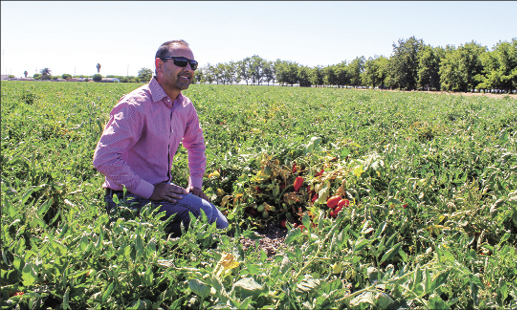
Derek Azevedo looks over a field of organic processing tomatoes outside Los Banos. Azevedo, who works for Bowles Farming Co., says growing processing tomatoes organically presents stark differences for fertilization and dealing with pests and diseases.
Photo/Kevin Hecteman


By Kevin Hecteman
Cannon Michael and his team were staring at a steep learning curve back in 2016, when the farm they operate started growing organic processing tomatoes.
“The first couple of years, not only are you battling weather and bugs and a lot of variables, but you’re also trying new techniques,” said Michael, president of Bowles Farming Co. in Los Banos. That included using natural fertilizers that took place of conventional nitrogen products piped straight to the plants via drip irrigation.
“We’ve been fortunate to have some folks that were willing to share some information about how they were dealing with that,” Michael said. “When you’re doing it on your own ground with your own people and trying to learn it yourself, it’s just a lot.” That said, he praised his team for sticking with it and producing results.
In the early going, the farm was harvesting in the 30- to low-40-tons-per-acre range from the organic-tomato fields.
“We’ve been able to, at least last year, get over 50 (tons per acre), and I’m optimistic, cautiously optimistic, that this year we can get over 50 on our organic tomatoes again,” Michael said, calling this “really encouraging when you look at the differential between the conventional and organic price. If you can make a yield, it actually works out pretty well.”
California farmers grew nearly 669,000 tons of organic processing tomatoes in 2021, according to California Tomato Growers Association figures. That represents 6.22% of the 2021 crop, which weighed in at nearly 10.8 million tons. The 2021 organic harvest is up slightly from 526,085 tons in 2020, or 4.65% of the 11.3 million tons harvested.
The organic share of the processing-tomato crop has been trending upward over the past decade. Organic represented 2.4% of the 12.1 million tons of tomatoes harvested in 2013 and still represents a small slice of the market.
As of May, processors reported intentions to buy 11.7 million tons of processing tomatoes, according to the U.S. Department of Agriculture National Agricultural Statistics Service.
Mike Montna, president and chief executive of the California Tomato Growers Association, noted the USDA report does not break out organic numbers.
“The organic crop’s going to be a little bit off,” Montna said, explaining that overall production could be down 10% to 15%.
Some of the decline is blamed on a crop disease, curly top virus, and the leafhopper bug that carries it.
Curly top was a persistent issue this season for Huron tomato grower Chris Coelho.
“Personally, I had a rough organic year this season on the processing tomatoes,” said Coelho, who manages tomato and garlic crops for his Fresno County employer.
“We had multiple flights of leafhopper,” said Coelho, who applied organic “knockdown-type materials” to fend them off. “You go through and spray, and if the wind’s still blowing the next day, it just blows in fresh leafhoppers,” forcing Coelho to send out the sprayers again.
“After several weeks of this,” Coelho said, “it gets to be a little expensive.”
Besides battling curly top virus, keeping unwanted vegetation in check is another challenge for organic growers, because most herbicides are off limits for organics.
Michael of Bowles Farming noted that while some conventional insecticides are targeted to specific pests, their organic equivalents are less precise and can wipe out the pests as well as lacewings and ladybugs, two insects he’d like to see more of.
“We are frustrated at times, because we really are always trying to work to keep that balance of beneficial insects and use the beneficial insects to our advantage,” Michael said. His farm may soon begin experimenting with hedgerows designed to attract beneficial insects and to lure pests away from the crops.
Growing organically also means relying on natural fertilizers such as chicken manure, said Derek Azevedo, Bowles Farming’s executive vice president.
“Every year you apply those, you’re applying almost three years’ worth of fertility,” Azevedo said, adding that this works out to a third available this year; a third next year; and a third the year after. “It takes time to build up that residual fertility as you’re transitioning into organic, and then building up your residual fertility to give your crops the opportunity to be supplied to their fullest.”
The first year, “it’s like the plants are in a cabinet full of canned food with no can opener,” Azevedo said. “You’ve got to allow the microbes to break that down over time.”
Converting a field from conventional to organic takes three years, during which the farmer is abiding by organic standards but has to sell the crop as conventional until certification is achieved.
Michael said another block of land is in transition, and he expects 10% of the farm’s acreage to be organic by next year. But he and Azevedo don’t want to push their luck.
“We’ve been cautious about how quickly we transition land into organic, just to make sure that we’re not getting out ahead of supply and creating a situation where we don’t have rotations to go into,” Azevedo said.
Michael said his farm rotates organic tomatoes with organic cotton.
Coelho said water supply challenges will affect organic tomatoes, along with everything else. With California already curtailing surface water deliveries, growers relying on groundwater may be further limited in pumping under the Sustainable Groundwater Management Act.
But Coelho sees no changes in how much he will plant for 2023 so far due to limited water. He said, “We’re going to actually hold our organic acreage steady, regardless of rainfall.”
He said he is planning for “a zero allocation” of surface water supplies. However, he said, “if it appears wetter than normal, then maybe we will plant more. But we would just operate assuming the worst.”
Those who can bring an organic-tomato crop to market will receive $165 per ton this year, compared to $105 per ton for conventional, Michael said.
“There’s much more risk on the organic side,” he said. “If you can manage it correctly, and if you can get a good yield and all those kind of things line up, the opportunity is there for good returns.”
But, he added, “You’ve got to be very, very, very precise.”
(Kevin Hecteman is an assistant editor of Ag Alert. He may be contacted at khecteman@cfbf.com.)





.svg.png)
